


When Steven “Steve” Copher, a young husband and father in San Diego, CA, was diagnosed with alpha-1 antitrypsin deficiency (Alpha-1) at just 36 years old, he was told that he had just four to five years to live. His wife, Amanda, refused to let that be the end of their story. Through education, persistence, and community, find out how the Copher family managed daily life, including homeschooling their two twin boys, while navigating Steve’s diagnosis and, ultimately, his life-saving lung transplant.
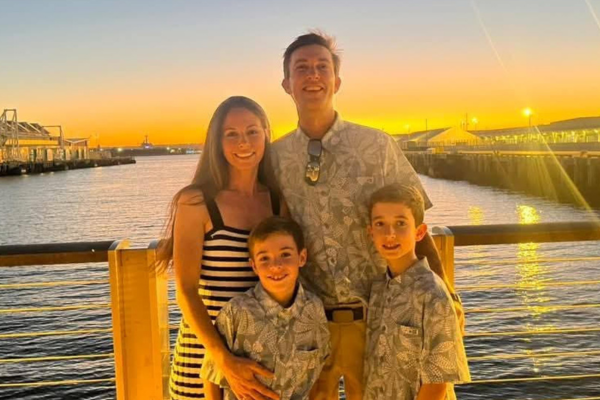
The Copher Family, Amanda, Steve, and their two boys, pictured in August of 2025, nearly one year after Steve’s transplant.
Steve and Amanda’s love story started the way some of the best often do, completely by surprise. It was her 25th birthday party at a Mexican restaurant in San Diego, CA, complete with an outdoor patio and a live band, and Steve joined the festivities as a friend of a friend.
“It was kind of unexpected,” she recalls. “I didn’t know he was coming.” They didn’t start dating right away, but the connection stuck. About a year later, they became a couple, and in 2014, they were married in San Diego.
By 2016, the family had grown. They welcomed twin boys who will turn 10 years old this coming June. Daily life was busy, but rewarding. Steve was working in construction as a foreman, a career he began pursuing at just 16 years old, focused on financial freedom, and his wife, Amanda, a professional hairdresser originally from Oregon, was caring for the boys during the day and keeping the household running. At the time, Steve’s health seemed steady, and like most young families, their focus was on making the most of their time with their children and each other.
When the twins started kindergarten in the fall of 2021, it was at the height of the national COVID-19 pandemic school reopenings. Children were required to wear masks, and almost immediately, the boys started getting sick and missing school. By Christmas break of that year, the school’s principal was already flagging attendance concerns.
“They were already at 80% attendance, and it was only Christmas break,” Amanda recalls. “And I was like, well, they’re getting sick at your school, and I’m not going to send them to school when they’re feeling sick.”
The family decided to pull them from the public school system and Amanda began homeschooling, a decision that would prove to be far more significant than she could have anticipated. “It was a challenge at first, because I had to teach myself how to teach,” she laughs. But when Steve’s illness later altered their lives, the flexibility of homeschooling became, in her words, “a blessing in disguise.”
It was the summer of 2019 when Steve first noticed something wasn’t right. He’d been sent to Montana on a six-week job assignment, flying home every two weeks to visit the family. But every time he returned to Montana, he found it harder and harder to breathe. He chalked it up to the altitude, as most people would.
By early 2020, however, he found that his breathing difficulties persisted. He saw his primary care physician, who took chest X-rays and ordered labs. The diagnosis he received was vague and somewhat puzzling: a combination of asthma and emphysema. He was given inhalers and sent home.
What neither Steve nor Amanda knew was that buried in his 2020 lab work was a critically low alpha-1 antitrypsin serum level. The physician had messaged Steve through an online patient portal, and Steve never saw it. There was no phone call, no follow-up, no further conversation.
“I was angry with this doctor, and it still angers me now,” Amanda says. “Had we known, it might not have progressed so fast. You know, you always think about the ‘what ifs’, and you have to kind of stop yourself.”
Steve continued on inhalers as his condition slowly worsened over the next three years.
By the end of 2023, Amanda had seen enough. His breathing difficulties had become severe, and she pushed him to see a pulmonologist. That pulmonologist pulled up Steve’s 2020 bloodwork, spotted the alpha-1 numbers, and told them he was nearly certain of the diagnosis, but he wanted to confirm it with fresh labs.
A full workup followed — imaging, spirometry, and bloodwork. The results came back and confirmed what his doctor suspected. Steve had alpha-1 antitrypsin deficiency (Alpha-1), and his lungs were functioning at just 15%. He was 36 years old at the time.
The pulmonologist delivered the prognosis over a Zoom call, just two weeks before Christmas. He told the family that Steve had approximately four to five years left to live without intervention.
“We were like, what the heck is that?” Amanda recalls first hearing the term Alpha-1. “And so we kind of researched it. And I was like, no way, this can’t be happening.”
As they researched the condition, more pieces of Steve’s health puzzle clicked. Steve was a ZZ Alpha, meaning both his mother and father were both Z allele carriers. A grandmother on his father’s side had died with half her lung capacity reduced from unexplained emphysema. Steve had also smoked for about 20 years, quitting once the breathing problems began years earlier. He’d also spent years working hands-on in construction without respiratory protection. None of it had ever been connected before.
Amanda continued to research the condition, doing what she had so many times before, educating herself to better inform and care for her family.
“I immediately started deep diving and researching,” she says. She found a Facebook group for the Alpha-1 community and connected with another woman named Amanda, an AlphaNet member also from Oregon who became an early lifeline. Amanda messaged back and forth with her on Facebook, gave her a list of steps to take, followed up after Steve’s first specialist appointments, and helped connect the family to a local AlphaNet Coordinator.
“She was so caring and so nice,” she says of Amanda. “She kind of opened the doors for me.”
While Steve continued to work full-time as a foreman, not totally comfortable with discussing his condition outside of close friends and family, Amanda continued to make connections within the Alpha-1 community whose members did their best to reassure and support her. Once Steve began Alpha-1 augmentation therapy infusions, they were connected with their current AlphaNet Coordinator, Carole Martin, who offered even more support and access to educational resources to the family.
“I wanted to talk to everyone that we could, just to get other perspectives of people actually going through the same thing,” she says. “The more knowledge you have, the more grounded you feel in your situation.”
She also moved quickly to test herself and the boys through a private testing service Amanda had recommended. She is not a carrier. The boys are carriers, but not affected, something the family plans to revisit in depth with the twins when they’re older.
Throughout 2024, as Steve underwent the lengthy transplant evaluation process, he kept working full-time as a foreman. While the work was no longer as physically demanding as it was in the beginning of his career, it still required long hours and early mornings. He was also now on oxygen full-time, a portable unit for when he was on the job site, and a more powerful oxygen concentrator at home. Amanda had quietly restructured their mornings so that all Steve had to do most days was walk out to his truck and make the drive to the latest job site. She prepped his meals, brought his lunch out to his truck, and opened the gate to their property located outside of the city.
One early morning in late September 2024, however, she awoke suddenly, realizing she had slept past her alarm. And Steve has opted not to wake her. He’d noticed she wasn’t sleeping well and tried to manage on his own.
“I wake up to this phone call at like 5:30 in the morning, and it’s him gasping for air, saying ‘tank,'” she recalls. She ran through the house searching for his oxygen tank. It wasn’t in its usual spot in the living room. She found it still on his side of the bed. “All I kept thinking about was, ‘What I am going find when I finally get to him?’”
She ran outside with the tank. He had been using his portable unit, but it wasn’t putting out enough oxygen for what his body needed. She got him stabilized and then she told him — this had to be his last day of work.
That same day, Steve had an afternoon transplant team appointment scheduled. He had been seen every two weeks as they worked to get him listed for a new set of lungs. By chance, their schedule had opened up and the team asked Steve to come in a few hours earlier, and when they saw him that morning, they told him he needed to be admitted to the hospital to wait for a donor match. It would allow them to monitor him and help him build up his strength before surgery.
Their boys came along to the hospital that day because there was no one else to watch them on such short notice. In the end, that timing was its own small grace. They were there when their father was admitted, already aware that he was sick, already aware he needed new lungs.
“There was a lot of crying,” Amanda recalls, “and a lot of hugging.”
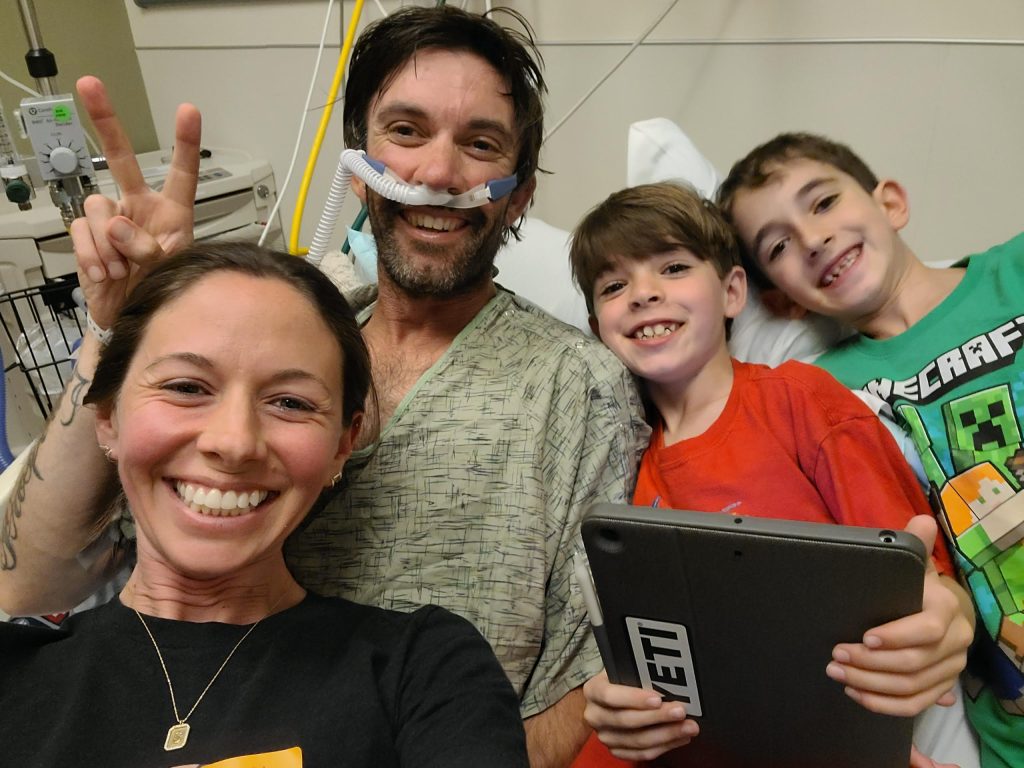
The family the day after Steve was admitted to the University of San Diego’s transplant unit on September 27, 2024.
The transplant team worked every available angle to move him up on the transplant list. One complicating factor was an immunological test result that indicated a less common viral exposure, meaning finding a compatible match would take longer than usual. Being inpatient at the hospital was itself a way to improve his position.
The team also wanted Steve to gain weight. He had become severely underweight, as his body was burning extraordinary amounts of energy just to breathe.
Around the time of his admission, Amanda began posting in a Facebook page titled “Breathing Hope, Steve’s Journey” to help keep family, friends, and their newfound community members informed of what was happening with Steve’s health.She hadn’’t posted in a couple of months, and they had kept the diagnosis private in their personal lives for some time, not even telling Steve’s workplace until the transplant workup began. Now, the page let people follow along. Strangers started watching. Support came from people they barely knew. When their blossoming support network caught wind that Steve needed to gain weight, DoorDash gift cards began pouring in from both close friends and acquaintances. Steve ate, gained weight, and, true to form, didn’t sit still.
“The doctors would always say, out of all the people that were in the hospital waiting for transplants, they were having to look for him, because he would be out walking around,” Amanda laughs. “He would grab a tank, walk the hospital grounds, eat his food, and come back when he was done.“
His wife brought the boys regularly, and they did homeschool from his hospital room. They completed their assignments, played card games together, formed a community with the healthcare staff they saw each day, and made it work as a family.
Amanda continued to keep their network updated. She wrote every post on their page carefully, meticulously editing, rereading, and making sure everything was accurate. And she made a deliberate choice not to mention a statistic she carried privately, that 50% of lung transplant patients don’t make it to the one-year mark. A statistic that is no longer true of modern transplant recipients who have a much more robust 80% chance of survival in their first year.
“I just wanted to stay positive,” she says simply.
Four weeks into his hospital stay, the team informed them there was a possible donor match. They were told that a member of the transplant team would be dispatched to evaluate the lungs, and a yes or no would follow.
On the night of October 23, 2024, they got word that the lungs looked good. Surgery was scheduled for the following day.
“No matter how much you can prepare yourself for such a huge surgery and not knowing the outcome…I wasn’t ready for it to happen yet, even though I was ready for him to be healthy, if that makes any sense,” she reflects. “It was good in the bubble.”
On the morning of October 24th, Steve was taken into surgery at around 11 a.m. Amanda and Steve’s mother waited together. The boys were at home with Steve’s sister, who had taken time off work to care for them. The surgery was expected to take seven to eight hours. It took just five.
That first night, they were allowed a brief visit, just a few minutes to say goodnight before returning the next morning. “I don’t think I had ever seen anybody hooked up to so many tubes and IVs,” she remembers. “It was pretty crazy.”
Amanda went home, put the boys to bed, sat up in her own bed with the light and TV on, and her phone volume turned up as high as it would go. She didn’t even realize she’d fallen asleep until a text from her sister startled her awake. “I was panicked,” she says. “I was so relieved it was her and not the hospital.”
The next morning, Steve was awake, intubated but communicative, writing his questions on a clipboard. Amanda still has those notes. She plans to put them in a memory box alongside other keepsakes from his hospital stay.
His first written question, she recalls fondly, was “When can the tubes come out?”
Steve recovered quickly. Within days, he was carrying his walker down the hospital corridor. Literally carrying it, because the back legs scraped on the floor, and he didn’t want to make noise. Just twelve days after surgery, he was home.
The recovery period brought its own challenges. For the first six to eight weeks, every car ride to the hospital, 45 minutes each way, was painful, as they had cut Steve’s sternum and every bump in the road registered. Amanda lined the car with pillows. They made the drive as gentle as possible.
Appointments were frequent in those early months, and Amanda’s parents stepped in to help in shifts. Her mother drove down from Oregon and stayed for six weeks, then her father flew down for four weeks. Steve’s mother also took time off to help the family manage their new routine. A relay of family support carried them through.
Steve started walking. First around the block, then down the long country road near their home in the rural outskirts of San Diego. By January, with his father-in-law walking alongside him, he was hitting 10,000 steps a day. The transplant team wanted him breathing deeply, working the lower lobes of his lungs, building capacity. Two months ago, his spirometry came back at 99%.
“It started in the upper mid to upper 80s,” Amanda says. “And then it just kept progressing.” She’s now brought a treadmill into the house and is encouraging Steve to start jogging — to breathe hard, to make his new lungs work.
“Get in touch with the Alpha-1 community immediately, get connected with AlphaNet, and just talk to as many people as possible, because everyone’s story is different,” Amanda says. “Knowledge is power. The more knowledge you have, the more grounded you feel in your situation.”
She also speaks to something she wishes had existed for her family during the transplant process: peer support specifically for those walking that road.
“I kept asking, I asked Carole several times, I just wanted to know somebody who had gone through a lung transplant,” she says. “There are so many unknowns, and that 50% was in my head. I just wanted to talk to as many people as possible.”
Amanda is grateful that University of San Diego’s transplant program, where Steve underwent his surgery, now offers caregiver support groups both before and after transplant, something she sees as genuinely essential. “Find those specific support groups and communities that have people going through the same thing,” she urges. “They become part of your family. And maybe not forever, but for that time being, and it’s going to be a while, they really become your family.”
Steve’s advice to his fellow Alphas? “Stay positive, learn as much as you can, and lean on those in your support circle when you need it.”
These days, the Cophers are refocusing on daily life and each other. The boys are back to a full homeschool rhythm, with field trips like exploring the aquarium and the local zoo back in the rotation, and group activities resuming. The family recently went camping in the California desert, five days away in their travel trailer, just the four of them. Their dream is to eventually take a long trip through Utah and beyond, exploring the country together.
“Our story is a long one,” Amanda reflects, “but we think it’s a good one.”